Or how atheism can be closer to Christ than some of our own religions dogmas
Recently, I shared a long conversation with an atheist. As I laid out my Christian ministry convictions, my interlocutor raised two points that gave me pause.
“I cannot believe that humans are fundamentally evil,” he told me, “nor that rewards or punishments after death—heaven or hell—should drive our actions. I don’t believe in God, but I do believe in humanity.”
My response surprised him: “That God—the ledger-like, moralizing system you refuse to believe in—I’ve spent much of my life deconstructing. I don’t believe in it anymore either.”
After he left, I thought back to Dostoevsky, who has his character Ivan say: “It’s not that I don’t accept God, Alyosha; it’s just that I’m returning my entrance ticket as respectfully as I can.”

Ivan does not deny the existence of a Creator, but he rejects the God “presented” by traditional theology—which justifies the church’s lack of empathy, if not outright cruelty, on Earth.
For Dostoevsky, a devout Orthodox Christian yet tormented by what he saw of the church in Tsarist Russia, authentic faith could only be born after passing through the “crucible of doubt.” He understood better than anyone that what the nihilists of his time rejected was not divine Love, but the dogmatic institutions and rigid moral frameworks imposed upon them.
Without his talent, I nevertheless found myself reflecting on the pages of my own book, Passport to the Bride of the Wedding, where I attempt to analyze how, over sixteen centuries of “Christendom,” we managed to replace the living communion of the early Church with dynamics of institutional control.
If the modern Western world today massively rejects the divine, it is not because it is impervious to God’s Love; it is because the ecclesiastical structures presented to it are a grotesque caricature of that same God.
It is time for a clear-eyed look at the great misunderstandings that produce atheists by the thousands, and to rediscover what Christ truly came to offer.
The Myth of Man’s Evil Nature, or The Cinder Block Theology
Traditional religion has often built its trade on guilt. It has established what I call “conditioning behaviorism“—a mass-produced theology where human beings are described as inherently depraved creatures, void of any goodness, that must be molded and polished to fit the mold. People are required to sign moral contracts, to adopt a “Canaanite patois,” to erase their unique qualities—to become obedient bricks.
But Christ never sought to build His Church with industrial, identical, gray cinder blocks. He builds with living stones. And in nature, no two stones are ever identical. They have strange shapes, rough edges, unique hues.

To say, “I believe in humanity,” as my atheist friend did, is not heresy; it is an echo of Genesis. Humanity bears the Creator’s imprint—an inalienable dignity, a capacity for love, for justice, and for beauty. The real problem the Bible calls “sin”—which they rejected wholesale—is not a denial of that original goodness; it is a tragic deviation.
It is the story of a quest for independence, the worship of our own egos, the seduction of Mammon, which drives us to barricade ourselves behind fortified cities, institutions built to “protect” us and build our happiness without others and without God.
Human beings are not “evil” in the sense of a total absence of light. They are wounded and lost, and their tragedy is that in selfishly seeking their own happiness, they end up destroying their neighbor’s.
When the Church spends its time condemning humanity instead of loving it as the Father loved it, it loses all credibility.
Heaven and Hell—or When Faith Becomes a Consumer Contract …
The second point of rupture my friend raised cuts to the very heart of religious perversion: the idea of a utilitarian faith, motivated by the carrot of heaven and the stick of hell.
Since the Edict of Milan in 313 and Christianity’s transformation into a state religion under Constantine and later Theodosius, the ecclesiastical institution has used the geography of the afterlife as a tool of social discipline. We have brandished the flames of Gehenna to subdue the people and used the promise of heavenly harps to purchase their docility.
In doing so, we transformed the message of Grace into a mere commercial or psychological transaction. We encouraged believers to seek their own immediate or post-mortem happiness before seeking the Kingdom of God and His justice.
In my book, I recall a word I received during a stay in England, which illustrates how we have privatized Grace:
“I anointed servants to dig wells in the desert… But when they found water, they built a wall around each well, a rim to protect the water… They called it ‘church’ and declared themselves its guardians…”
Religion has turned eternity into a personal consumer good. We pick our church the way we pick a restaurant, rate the service, and take out a “life insurance policy” for the afterlife. It’s a cut-rate gospel, a deceptive ad promising psychological comfort while draining the radical call of following in the Master’s footsteps.
Christ did not come to offer a system of moral retribution. He does not tell us, “Be nice and you’ll get a heavenly cookie.” The Kingdom He proclaims begins here and now. In Scripture, eternal life is not a chronological destination after the grave; it is the quality of a relationship with the living God, lived in the present moment.
Quit the gathering to Reclaim Communion
f we want to give the world a credible witness, we must shatter these religious curbs and become aqueducts again. We must admit that we have far too often replaced communion with meetings, reducing worship to a Sunday spectacle focused on the audience’s well-being instead of service to the living God and love of neighbor.
The key to human happiness—modern psychology itself is beginning to rediscover—does not lie in material wealth nor in the obsessive pursuit of individual comfort. It lies in our ability to form meaningful relationships.
Spiritually, this is what Jesus distilled into a single commandment: “Love one another, as I have loved you.” It is more blessed to give than to receive.
When we reduce faith to a fearful fortress to guard so-called Christian values, we trample the very heart of the Gospel. The Gospel is the story of a King of boundless generosity who flings open the doors of His house and invites even His enemies to His table.
Christian Anarchism in the confrontation of Idols
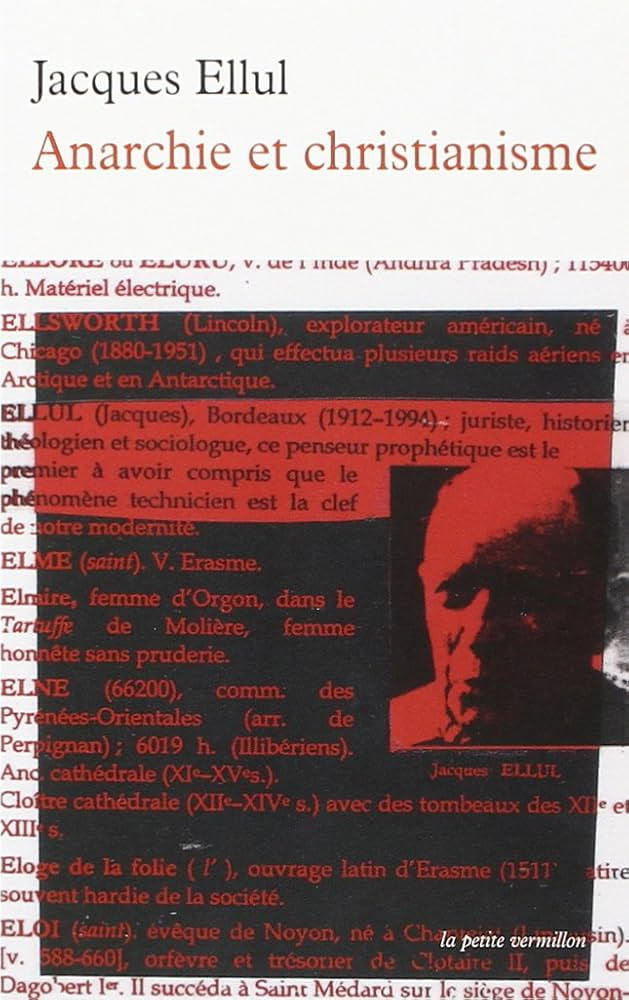
In a sense, my atheist friend is right to reject the god of religion—because Christ Himself fought it. In Dostoevsky’s poem : “Grand Inquisitor“, if the Grand Inquisitor has Jesus imprisoned, it is because the clerical system does not need a living, free Christ; it needs a manageable dogma to control the masses. To be Christian is to refuse the Inquisitor’s conditioning.
This is where Jacques Ellul’s thought serves as an indispensable scalpel for our consciences. In his major work The Subversion of Christianity, Ellul delivers a diagnosis of absolute radicality: How did the development of Christian society and the Church come to produce a civilization, a culture, institutions that stand in exact opposition to what we read in the Gospels? He explains that the great historical tragedy is the transformation of a subversive revelation into a managerial, utilitarian religion.
By allying itself with political power in the 4th century and later conforming to the efficiency demands of modern technological society, the Church committed a betrayal: it traded the Spirit’s radical freedom for power and moral control.
For Ellul, Christ did not come to found a new religion—because religion always seeks to instrumentalize the divine to reassure humanity or establish power—but to proclaim the end of all hierarchies.
In Anarchy and Christianity, he reminds us that faith in Christ is, by nature, a force of resistance against all the idols of this world: the State, money (Mammon), success, and social conformity. Christian anarchism, as Ellul understood it, does not consist of throwing bombs but of affirming that no human power is inherently legitimate and that our only allegiance belongs to the King of kings.
No, I do not believe in institutional labels any more than I believe in a theatrical God who hands out gold stars or metes out sadistic punishments. I believe in the Jesus who walked the dusty roads of Galilee, shattering the religious traditions of His time to restore humanity to its original dignity and affirming that hell is not inevitable.
To my atheist friend—and to all who look at our churches with skepticism—I want to say this: Your skepticism toward institutions is healthy. So stop staring at our tired religious constructions. Look to the Source. It is free, It is unmerited, and It belongs to no denomination. It is Christ—the source of life!
Mikaël Réale