
“I’m not asking for much… I deserve this, don’t I?”
In thirty-five years of ministry, I’ve lost count of how many times people have confided in me—often with a hint of reproach toward God Himself—some variation of the same complaint: “I’ve prayed, I’ve sacrificed, I’ve given… and nothing changes.” Just recently, someone told me: “I’m not asking for much… I deserve this. I’ve prayed, I’ve followed every church program, and I’m still in the same place.” Others go further, throwing in the towel in frustration: “It just doesn’t work.”
As if faith were a vending machine. As if God were a cosmic ATM: insert the right coin—the right prayer, enough giving, enough sacrifice—and out comes the blessing, mechanical, earned, inevitable.
When Grace become a “deal”
I have a somewhat clunky name for this logic: “the transactional gospel.”
A faith of quid pro quo, where God’s favor is no longer a gift but the product of a calculation. I pray enough → God owes me an answer. I tithe → God owes me prosperity. I’m faithful → God owes me a life free of trials.
Some movements have even turned this into a system—we all know those preachers who sell blessing as a financial investment, where faith becomes a product you buy on credit. But it would be too easy to assume this distortion only affects them. It has seeped in far more subtly, even into our most sincere hearts, in a quieter form: we don’t demand a private jet, we just demand to be heard—and we feel entitled to it, because we’ve paid the price.
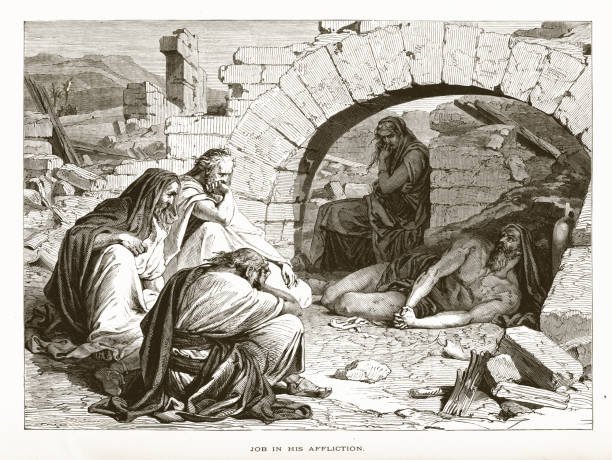
This is exactly the stance of that young woman who felt cheated. It’s also the stance of Job’s friends, convinced that his suffering had to correspond to some hidden sin—because in their theology, misfortune is always the bill for a poorly managed account.
Closer to home, it’s the stance of Paul when he faced a trial that no amount of faithfulness seemed able to erase.
Paul’s Thorn: The Failure of a Merit-Based Logic
In 2 Corinthians 12, Paul describes a trial he calls a “thorn in the flesh”—a messenger of Satan sent to torment him. He prays. Once. Twice. Three times. Nothing changes! If Paul had reasoned in transactional terms, this lack of response should have made him doubt himself—or God. Hadn’t he given everything? Wasn’t he the apostle to the nations, the man who had left everything behind, sacrificed everything? Didn’t he, more than anyone, have the right to demand his due?
And yet, it’s precisely here that God answers—not with a settlement of accounts, but with a revelation:

“My grace is sufficient for you, for my power is made perfect in weakness.” (2 Corinthians 12:9)
The Greek word translated as “sufficient,” arkeō, literally means to possess an inexhaustible strength. This isn’t a minimal service, a condescending “just deal with it.” It’s the opposite: a power without limits, already acquired, already available—not because Paul had finally earned it, but because it had always been there, freely given.
Did Paul ever find himself at the throne of merits, saying: Lord, look how well I’ve served You… It’s not fair, after all I’ve done for You over the years, You could have spared me this…?
It’s a posture we all know far too well. And it’s precisely this posture that God dismantles—not by granting the request, but by revealing a truth greater than the request itself: His grace was never something to be earned. It was always something to be received.
Why This Doctrine Does So Much Damage
The problem with the transactional gospel isn’t just that it’s theologically flawed. It’s that, over time, it produces bitter hearts.
When you believe you’ve “paid” for a blessing that never comes, only two outcomes remain: either you feel cheated by God—and bitterness takes root, sometimes for years; or you feel unworthy, never praying enough, never giving enough, never faithful enough—and then it’s guilt that gnaws at you, a sense of never doing enough to deserve what, in truth, was never meant to be deserved.
In both cases, you’ve left the ground of grace and entered the terrain of merit. And on that terrain, all you ever harvest is spiritual exhaustion. You fall back into the reductive view many have of the word “salvation”—as if it were nothing more than a distant promise, a ticket to the afterlife that we must, in the meantime, earn daily through good works. “At least you won’t go to hell—that’s something; in the meantime… don’t ask for too much!”
And yet the Greek word sōtēria, translated as “salvation,” is far broader: it means deliverance from an enemy, physical healing, spiritual healing. This salvation isn’t a deferred promise. It’s a life restored—here and now—in body, soul, and spirit—not as a reward for a well-lived life, but as a gift already accomplished in Christ.
What Grace Is Not—and What It Is
Grace is not a reward. It has never operated on an “if… then” basis. It doesn’t activate once you’ve hit a certain threshold of merit, like unlocking a new level in a video game.
It follows a different logic, one that’s even more disorienting to our merit-driven minds: “God opposes the proud but shows favor to the humble.” (James 4:6) Not to the high performers, not to the most devoted in prayer, not to the most generous givers. To the humble. That is, to those who have stopped presenting their bill to God.
This doesn’t mean that prayer, giving, or faithfulness are useless or optional—that would be another error, the opposite extreme. It means they are not the currency exchanged for a blessing we go begging for. They are the natural response of a heart that has already received everything, not the condition for receiving.
And What About the Trial That Persists?
Nowhere in the text do we see that Paul ever received healing from his thorn. And this silence is, in itself, an answer. If grace operated transactionally, God would have eventually caved—He would have settled the account. He doesn’t. He does something infinitely greater: He makes His power available within the trial itself, without waiting for it to disappear.
This is perhaps the hardest lesson to accept for those who have prayed for years without a visible answer: God doesn’t owe us anything, precisely because He has already given us everything. And this grace, already secured by the cross, doesn’t wait for our next tithe or our next prayer to activate. It is here! Inexhaustible. Available. Now!
So the next time the temptation arises to present your bill to God—I deserve this, I’ve done my part—maybe instead of approaching the throne of merits, we should simply approach the throne of grace. Not to demand what’s owed. To receive what’s given.
Mikaël Réale