Bye Mikael Réale
Happiness at Any Cost?
Listening to a recent interview with Boris Cyrulnik struck me once again by how normalized divorce has become in our society. Today, separation is so commonplace that entire generations of children grow up without ever knowing what a healthy family structure looks like. Yet, as I’ve written before in my article on divorce, remarriage, and God’s grace, there are situations where separation is the only possible way out. But these cases should remain the exception, not the rule.
Most Christian couples who divorce today do so for the same reasons as non-believers. In France, infidelity remains the leading cause of breakups, experienced as a betrayal of trust. Close behind is poor communication, which drives spouses apart until they become little more than roommates. Selfishness and the unequal division of mental load also weigh heavily—so much so that women, who initiate 75% of divorces, often feel pushed to leave. Incompatible personalities fuel constant arguments over differing values, while financial and professional stress erodes the marital bond daily.
We want everything, and we want it now—without effort. We confuse desire with need, pleasure with happiness. And it’s this confusion that’s killing families, couples, and, ultimately, society as a whole.
The Illusion of Happiness
« I deserve to be happy. »
A young woman once told her husband, a friend of mine: “I deserve to be happy, too.” She had just left him for a coworker. He—a man who was neither violent nor cruel—was stunned. Together, they had served God in missions. Together, they had fought for years to adopt a little boy, then about ten years old.
When her husband asked about their son, she added:
“It’s better for him!”
As if trying to reassure herself—and justify her actions at the same time.
Why had she decided to leave? Because she no longer found her husband “fun enough.” My friend worked 60 hours a week at his takeout pizzeria to provide for his family’s every need. But it wasn’t enough. She was trying to fill a void in her life, but by leaving, she only deepened it.
This story, unfortunately, is far from unique. How many couples separate today in the name of “the children’s happiness,” when the real reason is often an inability to give up their own comfort, their own desires? The pursuit of personal happiness, when it becomes an end in itself, always backfires. As Dr. June Gruber points out, people who chase happiness at all costs often end up feeling worse than when they started.
Happiness: A Devalued Concept
Happiness has become a buzzword, a wildcard we pull out to justify any decision. We talk about the “right to happiness” as if it were a fundamental, inalienable right. But happiness isn’t something we’re owed. It’s a journey, a path that necessarily involves self-denial.
In a society where individualism reigns, we’ve forgotten that collective happiness—the kind that sustains families and marriages—requires sacrifice. We’ve replaced agape love (the love that gives without expecting anything in return) with eros love (the love that seeks to fill its own emptiness). And that’s the tragedy: we no longer build anything together. We just consume.
Yet the Bible reminds us: “It is more blessed to give than to receive” (Acts 20:35). This principle, often overlooked, is the key to a fulfilling life. It becomes a reality for anyone who turns away from their selfish pursuit of happiness to become a source of blessing for others.
Selfishness: The Silent Poison
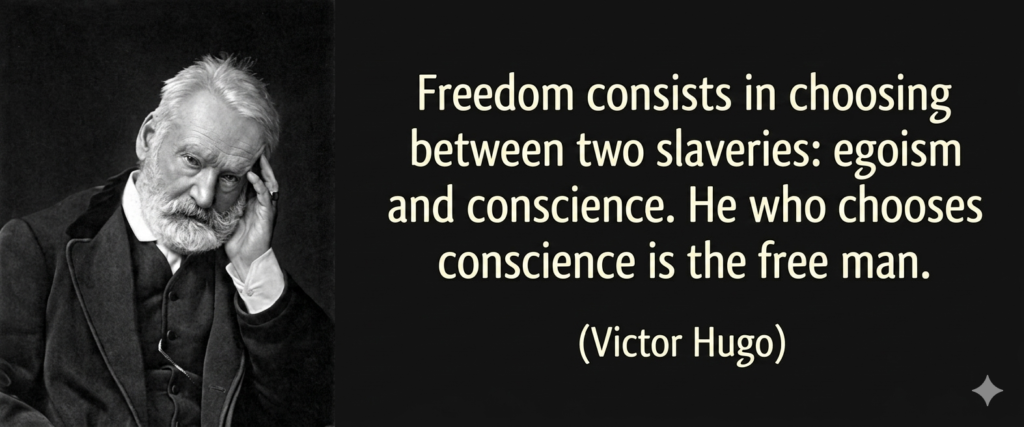
Selfishness manifests in countless ways within a marriage:
- The inability to listen: We no longer seek to understand our spouse but only to be understood. Conversations become monologues where each person waits for their turn to speak, never truly hearing the other.
- The refusal to sacrifice: We’re no longer willing to give up our own desires for the greater good. A dinner with friends? “No, I’d rather stay home.” A family outing? “I’m not interested.”
- The constant pursuit of instant gratification: If our spouse no longer meets our expectations, we look elsewhere. Social media, dating apps, ambiguous friendships—anything to escape the reality of a love that requires work.
- Minimizing our spouse’s efforts: We no longer see their sacrifices. 60-hour workweeks? “It’s not enough.” Years of struggling to adopt a child? “It’s not enough anymore.”
The Impact on the Family

Selfishness doesn’t just destroy marriages. It devastates children, too.
And then there’s the hypocrisy: We try to justify separation by claiming it’s “for the children’s happiness,” when in reality, we’re mostly seeking our own happiness—even at their expense.
Uprooted children: Repeated separations, blended families, constant moves—children grow up in instability, without solid foundations.
A distorted view of love: If Mom and Dad split up because it’s “not fun anymore,” how will the child ever understand that love also means persevering through hardship?
Inevitably, guilt: Even if we tell them “it’s not your fault,” children often feel responsible.
Christian Divorce: The Exception, Not the Rule
In a previous article, I addressed the issue of divorce in light of Scripture. God hates divorce, but He also understands the hardness of the human heart. Jesus Himself acknowledged one exception: adultery.
But adultery isn’t the only valid reason. Physical or psychological abuse, abandonment, or any situation endangering a person’s life or dignity can justify separation. Yet these cases remain rare—even among Christians, who divorce at the same rates as those outside the faith.
In churches today, we’re seeing more and more divorces for rather mundane reasons:
“We don’t communicate anymore…” “I’m not happy anymore…” “We’ve grown apart…”
At their core, these reasons all boil down to the same thing: selfishness. We no longer want to make the effort to understand, to forgive, to rebuild. We’d rather run. We refuse to accept that happiness isn’t found in satisfying our desires but in blessing others—even when it costs us.
And that’s the crux of the issue: Christian couples should be models. If we, who have Christ’s love as our foundation, give up at the first obstacle, what can we possibly preach to the world?
How to Fight Selfishness in Your Marriage
The first step is to acknowledge that we are all selfish. Even the best intentions can hide a desire for control, recognition, or personal satisfaction.
Ask yourself:
- Am I seeking first to understand, or to be understood?
- Do I give without expecting anything in return?
- Am I willing to set aside my own desires for the good of my spouse?
Selfishness often stems from dissatisfaction, but gratitude kills selfishness.
Make it a habit, every evening, to write down three things you’re grateful for about your spouse—instead of listing their shortcomings. A small gesture, a kind word, an effort… It doesn’t matter what it is. What matters is seeing your partner through the lens of grace and thanking God for them. By cultivating gratitude, you break free from the selfish pursuit of happiness and embrace the joy of giving.
Invest Time and Effort
A marriage requires care. Like a garden: if you don’t water it, it dies.
- Quality time: You don’t need grand outings. A quiet coffee together, a walk, a movie at home… What matters is being present.
- Communication: Not just talking, but listening—without judgment, without preparing your response. Just listening.
- Intimacy: Not just physical, but emotional and spiritual too. Pray together, share your fears, your dreams… Marriage isn’t a contract. It’s a covenant—a commitment before God and others. And a covenant isn’t broken at the first obstacle.
Reread your wedding vows. Remember what brought you together. And remind yourself: Love isn’t a feeling—it’s an act of the will. A choice that, paradoxically, brings more happiness than any selfish pursuit ever could.
Happiness Is Love That Endures
We’ve been sold a fantasy in pulp novels and TV movies: happiness that’s easy, instant, effortless. But that kind of happiness doesn’t exist. Real happiness—the kind that withstands storms—comes through self-giving, forgiveness, and perseverance.
Selfishness, on the other hand, is a gravedigger. It buries couples, families, and dreams.
So before you use “happiness” as an excuse to justify separation, ask yourself: Is it truly happiness I’m seeking… or just my own comfort?
Because in the end, happiness isn’t about being happy. It’s about making others happy. For “love does not seek its own interest” (1 Corinthians 13:5).
Mikaël Réale