
LZionism is a political and ideological movement that emerged in the late 19th century, aiming to establish a national homeland for the Jewish people. The term derives from “Zion,” a hill in Jerusalem symbolizing the Land of Israel in biblical tradition. Officially founded in 1897 by Theodor Herzl, an Austrian Jewish journalist, Zionism arose in response to rising antisemitism in Europe and the quest for a Jewish national identity after centuries of diaspora. Modern Zionism draws on both religious motivations (the return to the Promised Land) and political ones (the need for a state to protect Jews from persecution). In his 1896 work The Jewish State, Herzl proposed the creation of a Jewish state as a solution to the “Jewish Question.”
The Balfour‘s Déclaration (november 1917)
This is a letter from the British Foreign Secretary, Arthur Balfour, addressed to Lord Rothschild, a leader of the British Jewish community. It expresses the British government’s support for “the establishment in Palestine of a national home for the Jewish people,” while stipulating that “nothing shall be done which may prejudice the civil and religious rights of existing non-Jewish communities.” Motivated by strategic interests (securing Jewish support during World War I) and ideological sympathy for Zionism, the Balfour Declaration marks a turning point in the international legitimization of the Zionist project.
After the war, the Allied Powers (United Kingdom, France, Italy, and Japan) convened in San Remo (April 1920) to redraw the map of the Middle East. The Treaty of San Remo incorporated the Balfour Declaration into international law by entrusting Britain with a mandate over Palestine (officially approved by the League of Nations in 1922). This mandate included the responsibility to “place the country under such political, administrative, and economic conditions as will secure the establishment of the Jewish national home,” while safeguarding the rights of other communities.
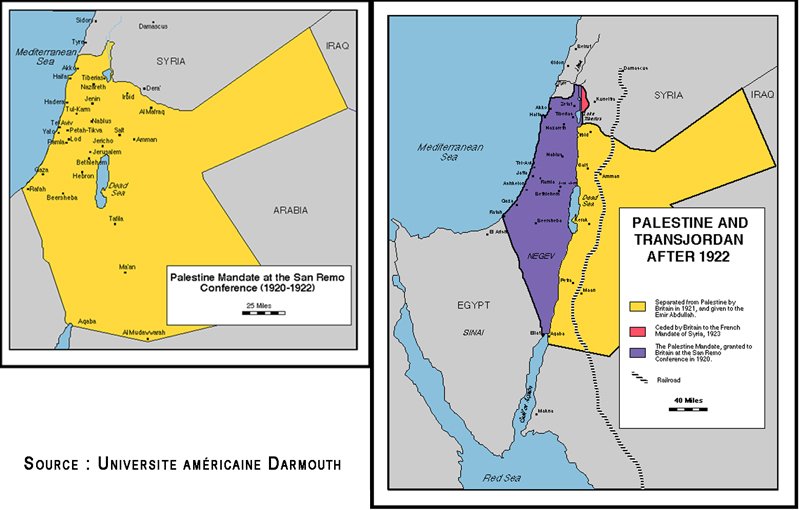
This plan proposed the first two-state solution for the future of Mandatory Palestine. West of the Jordan River, the future Jewish state would allow for increasing immigration, known as Aliyah; to the east, Transjordan (now Jordan) would become an Arab state under British protectorate.
It is noteworthy that Transjordan (present-day Jordan) accounted for approximately 77% of the original territory of the British Mandate for Palestine (90,000 km² out of a total of 118,000 km²). Thus, as early as 1922, Jordan (Transjordan) was nearly 3.5 times larger than the territory allocated to the Jewish state in 1947—and far larger than present-day Israel (22,000 km²), which corresponds to the area west of the Jordan River. Some now advocate for this same territory to be divided once again between Israel and the so-called “occupied” territories.
The création of the state of Israël.
The Zionist movement culminated in 1948 with the creation of the State of Israel and the establishment of Jordan, as envisioned by the League of Nations—and later the United Nations, which, upon its founding, pledged to honor all treaties of its predecessor.
After decades of pogroms, Jews finally regained a nation, a state capable of protecting them on part of their ancestral land. This achievement is seen as a triumph for the Jewish people, but it also sparked enduring conflicts with their new Arab neighbors, who view Zionism as a cause of dispossession.
Yet, Jews accepted just a quarter of the territory originally proposed for Palestine. They did not ask for more; they wanted peace. Looking at a map of the Middle East, one might wonder: Who truly poses a threat to whom, given Israel’s size compared to the surrounding Arab nations?
Demographically, Israel (with a population of about 10 million) represents less than 2% of the total population of the regional bloc.
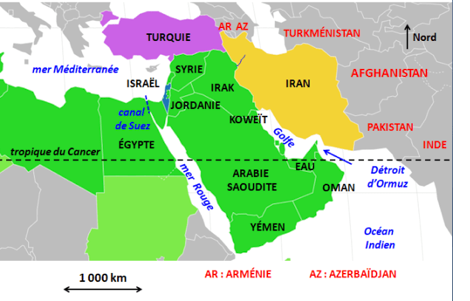
In terms of land area, the contrast is even more striking than with population. Israel is a tiny territory compared to the geographical giants surrounding it.
To put it into perspective, Israel covers roughly 22,000 km²—about the size of Picardy! Opposite it stands an Arab-Muslim world spanning over 15 million km².
Yet, even this seems too much for the nations around it, which, since 1948, have had one singular goal: the elimination of what they perceive as an occupying power or a colonial entity.
One, two, three … wars, and peace proposals …
Between 1947 and 2020, Israel accepted at least seven or eight major international or bilateral initiatives aimed at achieving peace and territorial compromise.
While each of these episodes remains the subject of intense historical debate regarding the true conditions and intentions of both sides, it is notable that the Arab parties systematically rejected these plans. This began in 1947 with the Arab leaders’ rejection of the UN Partition Plan, which called for a single Arab state over all of Palestine.
In 1967, following the Six-Day War—which they had initiated—the Arab League issued the “Three No’s” of Khartoum: “No to peace, no to recognition, no to negotiation.”
In 2000, at the Camp David II Summit, Yasser Arafat rejected Ehud Barak’s proposal, deeming it insufficient on territorial terms and the refugee issue. Then, in 2020, the Palestinian Authority categorically rejected the Trump plan, judging it too favorable to Israel.
The refugee issue.
The Palestinian refugee status is passed down from generation to generation, unlike the status of other refugees worldwide, due to the specific mandate of UNRWA. Established in 1949, this UN agency was designed to maintain refugee status even for descendants. As a result, Palestinians born outside Palestine—who have never lived there—are still classified as refugees. This approach maximizes the number of individuals concerned, amplifying diplomatic pressure on Israel.
Arab countries have deliberately refused to grant citizenship to Palestinian refugees. This policy, decided by the Arab League as early as 1959, aims to prevent their assimilation and preserve their so-called “Palestinian identity”—a distinct identity that had not previously existed in its current form—as well as their “right of return” to a Palestine emptied of its Jewish population. In Lebanon, Syria, and Egypt, Palestinians often remain stateless, denied civic and economic rights, and confined to refugee camps. This approach stems from the fear that integrating Palestinians would lead them to abandon their right of return, thereby weakening territorial claims against Israel.
In summary, the hereditary transmission of refugee status and the refusal to grant citizenship are political choices intended to perpetuate the Palestinian issue as an unresolved problem. The refugees are thus victims not of Israel, but of the dogmatic policies of the Arab countries that “hosted” them! This situation is primarily the result of deliberate political decisions by Arab states and the Arab League, which have created entire generations of stateless individuals—not because of Israel, but due to a strategy that exploits their plight for an unresolved political cause. As of 2025, UNRWA registered approximately 5.9 million refugees.
In reality, it is estimated that between 1948 and 1950, the number of Palestinian refugees ranged from 700,000 to 750,000 people. This figure corresponds to the period of the first Arab-Israeli War, which Palestinians refer to as the Nakba, or “Catastrophe.”
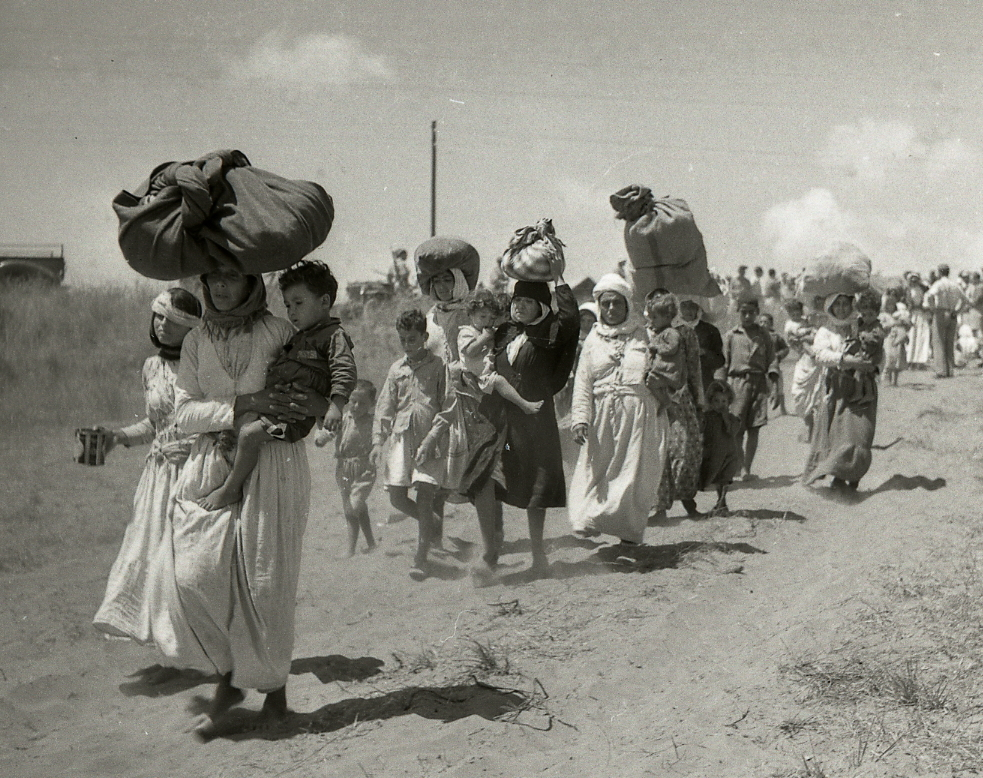
Estimates of the number of refugees varied depending on the source at the time. The United Nations (via a 1950 UNRWA report) estimated the number of refugees at approximately 711,000, while Arab countries claimed the figure was closer to 900,000. These refugees dispersed to areas on the periphery of the conflict zones:
- Judea and Samaria (later occupied and annexed by Jordan as the “West Bank”): ~280,000 people
- Jordan (then Transjordan): ~70,000 people
- Gaza Strip (under Egyptian administration): ~190,000 people
- Lebanon: ~100,000 people
- Syria: ~75,000 people
In parallel, following the establishment of the State of Israel in 1948, an estimated 850,000 to 900,000 Jews were forced to leave, were expelled, or fled from Arab and Muslim countries in the Middle East and North Africa. Unlike Palestinian refugees, these Jewish refugees were no longer considered refugees upon their arrival in Israel.
This raises a critical question: How did a country of just 22,000 km² manage to integrate nearly one million refugees within a year, while Lebanon, Jordan, Syria, and Egypt remain unable—or unwilling—to do so after three-quarters of a century?
“Let’s talk now about the ‘occupied territories’…”
The first partition of Mandatory Palestine occurred in 1922, as we’ve seen, when the British separated Transjordan (east of the Jordan River) from the rest of Mandatory Palestine. Transjordan became an Arab emirate in 1921 and later an independent kingdom in 1946—what is now modern Jordan. This 1922 partition was thus the first territorial division between a future Jewish state in the west and an Arab state (Transjordan) in the east.
This 1922 division established a border between Transjordan—the future Kingdom of Jordan, east of the Jordan River, reserved for Arabs—and Palestine west of the Jordan River, where the British Mandate was tasked with facilitating Jewish immigration and the creation of a Jewish national home.
The Treaty of San Remo provided the legal framework for both the British Mandate and the Jewish national home. This is a fundamental yet often overlooked point in the legal debate. It was not merely a statement of intent but a binding international legal instrument, serving as the foundation for modern international law in the region. However, the concrete territorial partition took place in 1922, when the British excluded Transjordan from the territory intended for the Jewish national home. This partition reduced the land originally allocated to the Zionist project by 77%, reserving Transjordan for Arab sovereignty.

However, in 1947, the UN proposed a new partition plan for Palestine west of the Jordan River, calling for the creation of two states (one Jewish and one Arab) and an international status for Jerusalem. While Israel accepted this plan, the Arab states rejected it, and it was never implemented. Instead, the 1948–1949 war redrew the borders de facto.
“No, I am not Jewish—and yes, I AM A ZIONIST!
Zionism is, above all, the vital affirmation of a people who refuse to vanish. Born in the late 19th century in response to European antisemitism and pogroms, it embodies the Jewish people’s right to a homeland where they can live freely, in safety, without fear of extermination. It is not an ideology of conquest, but a cry for survival: after two thousand years of exile, persecution, and genocide, the Jews finally have a state—Israel—where they can defend themselves and exist as a nation. With its 22,000 km², a tiny sliver of the Middle East, this country has never threatened regional balance or global peace. And yet, it is demonized, turned into a universal scapegoat, as if its very existence were an insult.
I am not Jewish, but I am a Zionist, because no one can deny this fundamental right to life.
Israel is not perfect: its policies, its governments, and its excesses often trouble me. Its “holy land” is not always holy, and its contradictions are real. And yet, despite its flaws, Israel remains the only functioning democracy in the Middle East, where Arab Israelis enjoy more rights than Jews or Christians in any Arab country.
This paradox speaks volumes: Israel is judged under a microscope, while its enemies escape all criticism.
Zionism is also a rejection of hypocrisy. Those who scream against Israel turn a blind eye to dictatorships, massacres, and the endemic antisemitism of the Arab world. Israel is not the problem of the Middle East; it is the convenient pretext for those seeking a cause to unleash their hatred. Defending Israel does not mean blindly approving its actions, but refusing to deny its right to exist. And that is a matter of justice, not religion.
Mikaël Réale.